Article by Chanelle Yehia
For many dedicated F1 fans, a month-long summer shutdown with no Grand Prix to watch is thoroughly underwhelming. However, the summer break has given teams the chance to develop upgrade packages and modify racecar components; all of which were debuted at the Dutch Grand Prix. At Zandvoort, the sport’s relentless and constantly evolving development war is being led by McLaren, who have brought aggressive innovations to the weekend.
Crinkled Papayas
Most notably, McLaren have introduced a new rear wing endplate. Rather than having a flat/smooth endplate, the papaya team have opted for a more visually interesting option, where the wing contains multiple “crinkle cuts”.
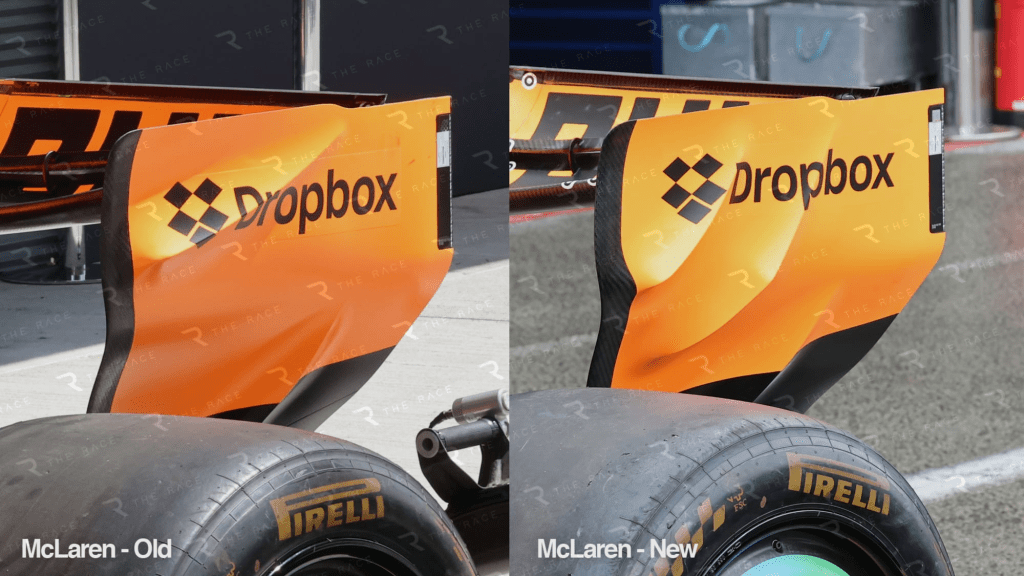
McLaren’s crinkle cut rear wing endplate at Zandvoort 2026 as shown above.
The ultimate aim of this design is to control turbulent air that comes from the car’s rear tires (also known as tire squirt). The crinkle elements redirect and accelerate air in an upwards direction, creating an aerodynamic “upwash”. This forms a low-pressure wake at the back of the car, effectively acting like a suction zone. Since air naturally travels from areas of higher pressure to areas of lower pressure, the air underneath the car’s floor is forced to the rear. The air’s acceleration produces a low-pressure zone that generates downforce and “glues” the vehicle to the track.
This design, although incredibly inventive, is not entirely new. Rippled endplates were first implemented by both Alpine and Aston Martin for the 2023 Monaco Grand Prix. Like Laufey with jazz or Olivia Rodrigo with 80s British rock, McLaren is leading the way to bring back the crinkle!
Aerodynamic Artistry
The team also brought upgrades to their rear engine cover, an aerodynamic shell that encases mechanical elements such as the power unit and radiator. The engine cover was reprofiled to efficiently guide air flow to the rear diffuser, thus enhancing downforce.
McLaren’s adjustments to the engine cover also provide benefits for controlling messy, turbulent air emitted from radiator cooling processes. The deepened “waterslide channels” above the sidepods enable a shield of high-speed air to surround the car, preventing chaotic radiator air from interfering with airflow underneath the floor. Furthermore, McLaren used surgical venting rather than large vents for radiator cooling operations; small, millimeter-precise gills direct turbulent air away from the main airflow, so the car’s critical downforce is not interrupted.
Super Scoops
Additionally, McLaren introduced updated rear brake duct inlets (scoop-shaped components mounted inside of the car’s rear wheels). The modified scoop shape catches cool air and passes it over the brake discs, so the rear tires don’t overheat. Moreover, smaller winglets are attached to the outside of the duct, which generate more downforce during high-speed corners (which Zandvoort has a lot of). Overall, this element brings two essential contributions: brake cooling and downforce generation.
Potential Payoff
With numerous aggressive developments and innovative upgrades, McLaren engineers have hit the ground running for the second half of the season. However, it’s uncertain whether this program of ambitious development will be enough to help McLaren fight in the Constructors’ Championship. In the end, only time will tell!


Leave a Reply