Article by Lucy Do
After a long summer break with F1 silly season in full swing, we welcome the second half of the Formula 1 season starting this weekend with a Sprint format in the beautiful Netherlands. Home to Circuit Zandvoort and 4x World Champion Max Verstappen, the Netherlands has a history of action-packed weekends and interesting strategy choices, so prepare for the resumption of this already exciting season. Unfortunately, this weekend will be the last F1 Grand Prix held at Zandvoort, as the beloved track has been removed from future F1 seasons, 6 years after its return to the calendar in 2021. On a more optimistic note, we still have one more weekend next to the sand dunes ahead of us. With all that said, let’s look at what the teams have to consider and what could be to come (although it is quite rare that we can predict any of the events of a F1 race).
Track conditions and weather
After last year’s rain-based tyre confusion, this year’s forecast suggests possible light rain early in the day and a heavy cloud cover for Friday and Saturday, which includes Zandvoort’s first Sprint. However, Sunday appears to be relatively clear of rain, but anything could change come race day. Air temperatures will be around 19 degrees Celsius (66 degrees Fahrenheit) on Friday, 17 degrees Celsius (63 degrees Fahrenheit) on Saturday, and 18 degrees Celsius (65 degrees Fahrenheit) on Sunday, giving the drivers and the cars relatively comfortable temperatures to perform at. Track temperatures will be in the low 30s Celsius (90s Fahrenheit) throughout the weekend.
Circuit Zandvoort is a clockwise, 4.259 km (~2.65 mi) track featuring 72 laps of 14 turns and two straight mode zones between Turns 14 and 1 and Turns 10 and 11. The track is particularly narrow and is packed with turns, which make overtaking especially difficult. This track also features two of my many favorite corners in F1, which are Turns 3 and 11, the famous banked turns which also sit at a stunning 18–19-degree angle (I highly recommend watching Nico Rosberg break down this track on his YouTube, his analysis from a driver’s perspective is comprehensive and easy to digest!). This makes Zandvoort the only track on the current F1 calendar to have truly banked corners. Mother Nature and the harsh nature of the track itself always forces the teams to overcome these unique aerodynamic and strategic challenges.
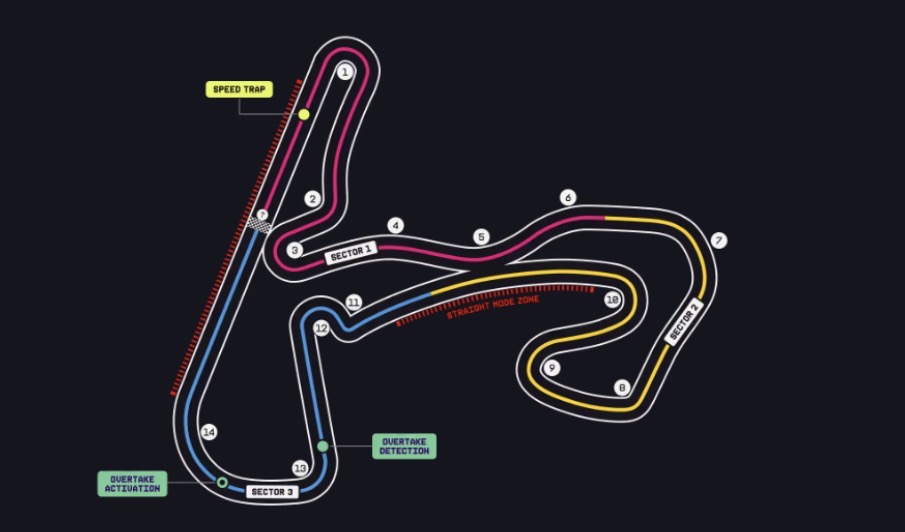
This track has medium traction, asphalt abrasion, grip and braking, and slightly better downforce, but has extreme tyre stress. The grip is an especially difficult thing to consider, as this GP tends to be very windy and the track is located very close to a few beaches, meaning that the sand blown onto the circuit can change and worsen the grip throughout the weekend in between sessions. Teams will need to account for this, as well as for the high level of aerodynamic downforce needed, and decide for the weekend using the singular free practice due to the Sprint Weekend format.
Tyre Strategies
This year’s tyre compounds are the same as last year’s; C2 as the hard tyre, C3 as the medium tyre, and C4 as the soft tyre. Being a clockwise track, the front left tyres will take quite a beating, which is another thing the teams will have to watch out for when planning pitstops. Similar to 2025, we may see many teams alternate between the medium and hard tyres with possible short stints on softs, although many drivers in years past have proven that longer stints on softs can be done well. Zandvoort is famous for its rainy races, so even though rain is not currently projected for race day, anything could change. The average pit stop time loss for this race is around 18.09 seconds, and there is a 60% chance of both a Safety Car and a Virtual Safety Car (VSC).
Last year in Zandvoort
Now that we’ve looked ahead at the upcoming weekend, let’s look back at last year’s Dutch Grand Prix.
Oscar Piastri took P1, which remains his most recent win, delivering an extremely controlled race after starting on pole (which makes the pole-win conversion rate 100% in Zandvoort since its return in 2021!) ahead of his teammate, Lando Norris, who retired later in the race due to a mechanical issue in lap 65. Max Verstappen finished P2 at home and his now teammate, Isack Hadjar, took his first podium finish in P3. It was a particularly difficult race for Ferrari as they saw both Lewis Hamilton and Charles Leclerc retire on laps 23 and 53, respectively. Hamilton suffered a solo crash as light rain hit the asphalt, and Leclerc, coming out of the pits on fresh softs, encountered a dramatic crash with Kimi Antonelli.
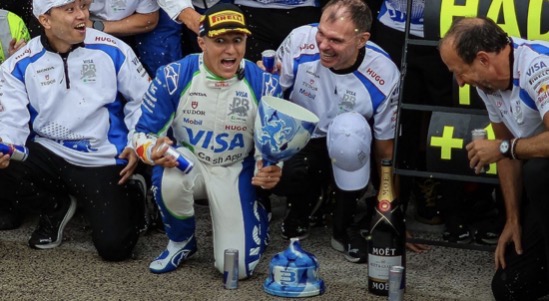
Throughout the race and three Safety Cars, many opted for a two-stop race and a majority of the grid started on medium tyres apart from 6 cars, including the winning McLaren. The tyre compounds chosen for last year’s race were the C4 for the softs, C3 for the mediums, and C2 for the hards. The weather proved to be confusing during the race as light rain came and went just enough to mess with the strategists, but the slicks remained on for all the cars throughout the entire race.
Strategy is one of the most predictable and unpredictable parts of any race weekend, but it can provide good insight as to what we can expect from the teams up front all the way down through the midfield. Although we say goodbye to this beloved circuit and race after 2026, there are still plenty of challenges left on the table for teams and drivers alike. Whatever the Netherlands brings us this weekend, rain or shine, it sure to be a packed and exciting time with cars back on track. Happy race week!


Leave a Reply